
February 27, 2026
AI Chatbot Builder vs Traditional Automation: What Should Your Business Choose?
A business owner installs a chatbot on their website. Two weeks later, they turn it off — because customers kept getting stuck in loops, receiving wrong answers, and eventually contacting support anyway, now frustrated. The chatbot made things worse.
This story is painfully common. It's not because chatbots don't work — it's because most businesses deploy the wrong type of chatbot for their context. In 2026, the chatbot market is broadly split between two fundamentally different paradigms: rule-based traditional automation and AI-powered chatbots driven by large language models (LLMs).
The difference isn't just technical — it changes every business outcome: what you can automate, how customers feel about the interaction, how quickly you can deploy, and what it ultimately costs. This guide breaks down both approaches honestly, shows you how to choose the right one, and explains why the most sophisticated businesses in 2026 aren't choosing between them — they're using both.
Understanding Rule-Based Automation: How It Works and Where It Fits
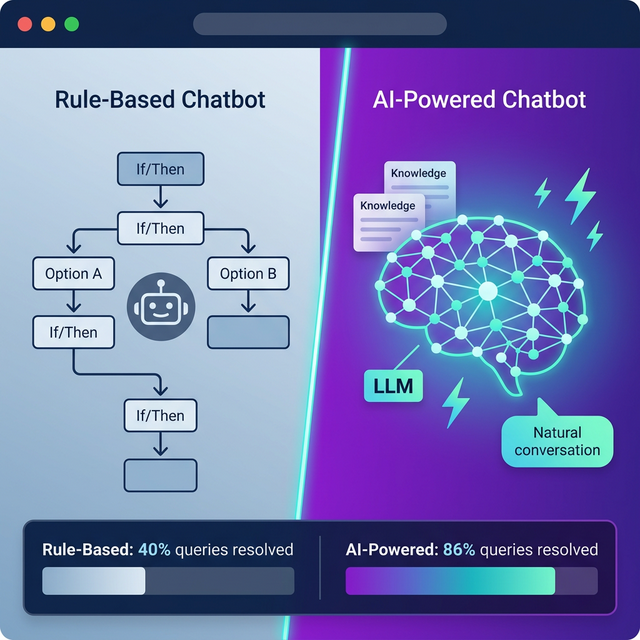
Rule-based chatbots — also called decision tree bots — operate on a simple principle: if the user says X, respond with Y. Every possible conversation path is predefined by the builder. The bot has no ability to understand context outside those defined paths. It matches input to rules; when no rule matches, it fails.
How Traditional Rule-Based Bots Work
- User sends a message; the bot scans for keyword matches or button selections
- Matched keyword → bot triggers a predefined response or next step
- No match → bot delivers a fallback message ("Sorry, I didn't understand. Please choose from the options below.")
- Multi-step flows are built as a branching tree: question → answer → branch → question
- The bot cannot infer intent, understand variations in phrasing, or answer anything not explicitly programmed
Where Rule-Based Automation Still Works Well
Despite their limitations, rule-based bots are not obsolete. They remain effective in specific, well-defined scenarios:
- Highly structured processes: Appointment booking, order status checks, support ticket creation — where the user journey is predictable and finite.
- Small-scale deployments: Businesses with narrow product/service offerings and a limited set of customer questions.
- Compliance-sensitive environments: Where every response must be pre-approved by legal or regulatory teams — since rule-based bots produce only explicitly programmed outputs.
- Lead qualification with fixed criteria: When you're asking a defined set of questions in a defined order and don't need the bot to handle variations.
The Core Problems with Rule-Based Bots in 2026
- Coverage rate: Even well-built rule-based bots typically handle 30–50% of inbound queries. The rest trigger fallbacks or escalations.
- Maintenance cost: Every new product, policy change, or query type requires manual updates to the decision tree — which becomes exponentially complex over time.
- Customer experience: Users who encounter limitations ("I didn't understand that") report significantly lower satisfaction than users who speak to either a human or a capable AI.
- Language inflexibility: "What does it cost?" and "How much?" and "What's the pricing?" are the same question — but a rule-based bot may only recognize one phrasing.
AI-Powered Chatbots: LLM Knowledge Base Bots Explained
AI chatbots powered by large language models (LLMs) operate on a completely different foundation. Instead of matching keywords to rules, they understand natural language — the intent and meaning behind a message, regardless of how it's phrased.
The key innovation for business use is the knowledge base: you train the AI on your specific content — product documentation, FAQs, pricing pages, support articles, and policies. The AI then answers questions based on that content, in natural language, without requiring you to manually program every possible Q&A pair.
How LLM Knowledge Base Bots Work
- You upload your business content: website pages, PDF documents, FAQ sheets, product manuals, pricing tables
- The LLM processes and indexes this content, building an understanding of your products, policies, and common questions
- When a customer sends a message, the AI retrieves the most relevant content from the knowledge base and generates a natural, accurate response
- If the answer isn't in the knowledge base, the bot acknowledges this clearly and escalates to a human — rather than guessing
- The bot understands follow-up questions in context: "How much does it cost?" → "Does that include setup?" → "What about annual billing?" — all handled as a flowing conversation
What LLM Bots Can Do That Rule-Based Bots Cannot
- Handle infinite query variations with a single knowledge source
- Answer multi-part questions in one response
- Understand negative phrasing ("I don't want X, I need Y")
- Maintain conversation context across multiple turns
- Provide nuanced answers based on customer context ("For your team size, I'd recommend...")
- Update automatically when you update your knowledge base — without rebuilding a decision tree
In practice, LLM knowledge base bots resolve 75–90% of inbound queries without human involvement — compared to 30–50% for even sophisticated rule-based bots. See how TextNow's AI bot builder implements this with your own content.
Dialogflow Integration: When You Need Precision NLU
Google's Dialogflow is a Natural Language Understanding (NLU) platform that sits between pure rule-based and full LLM approaches. It uses intent classification and entity extraction — meaning it identifies what a user wants (intent) and relevant details within the request (entities) with precision.
For example: "Book me a flight to Dubai next Friday" — Dialogflow identifies intent: book_flight, entity: destination=Dubai, entity: date=next_Friday. This extracted data can then trigger backend actions (checking availability, creating a booking) with high reliability.
When Dialogflow Integration Makes Sense
- Complex transactional bots: Where the bot needs to extract specific structured data (dates, numbers, locations, product IDs) to trigger backend processes
- Multi-language businesses: Dialogflow has enterprise-grade multilingual support across 30+ languages — useful for businesses serving diverse markets
- Existing Dialogflow infrastructure: If your team has already built intents and training phrases in Dialogflow, connecting it to a platform like TextNow extends its reach to WhatsApp, Instagram, and other channels without rebuilding from scratch
- Regulated industries: Where you need full control over exactly what the bot can and cannot say — Dialogflow's intent-based approach is more constrained than a free-form LLM
TextNow supports Dialogflow connection alongside its native LLM and visual workflow builder — letting businesses that have invested in Dialogflow bring it into a full omnichannel context without rebuilding.
Visual Workflow Builder (AI Studio): The No-Code Middle Ground
For many businesses, the ideal isn't a pure LLM bot or a pure rule-based bot — it's a visual workflow builderthat combines structured conversation design with AI capabilities. This is what AI Studio inside TextNow delivers.
In a visual builder, you design conversation flows on a canvas — dragging and dropping blocks for messages, questions, conditions, and actions. But unlike pure rule-based tools, each block can leverage AI: the bot uses natural language understanding to match user inputs to your branches, and can inject LLM-generated responses for knowledge questions within the flow.
What You Can Build with a Visual Workflow Builder
- Structured lead qualification flows with multi-path branching based on budget, timeline, and use case — where each question is asked naturally and the bot handles varied responses
- Appointment booking sequences with integrated calendar connections, confirmation messages, and reminders
- E-commerce support flows — order lookup, return initiation, product recommendations — all within a designed conversation architecture
- Human handoff triggers at specific points in the flow (e.g., when a customer says "speak to someone" or when their lead score crosses a threshold)
- Multi-channel deployment — the same flow deployed simultaneously on WhatsApp, Instagram, Facebook, and web chat
The advantage of the visual approach is that non-technical team members — marketing managers, support leads, sales operations — can build, test, and modify flows without developer involvement. Most businesses go live within a day.
Pros & Cons: Traditional Automation vs AI-Powered Systems
Here is an honest comparison of the three approaches across the dimensions that matter most to growing businesses:
| Dimension | Rule-Based Bot | Dialogflow NLU | LLM + Visual Builder (TextNow) |
|---|---|---|---|
| Setup time | 1–2 days | 1–4 weeks | 2–8 hours |
| Technical skill required | Low | High | None (no-code) |
| Query resolution rate | 30–50% | 60–75% | 75–90% |
| Handles new questions | ❌ No | ⚠️ With retraining | ✅ Yes (knowledge base) |
| Natural conversation | ❌ Limited | ⚠️ Structured | ✅ Yes |
| Multi-channel deployment | ⚠️ Often one channel | ⚠️ Requires integration | ✅ All channels, one build |
| Maintenance burden | High (manual updates) | High (intent retraining) | Low (update knowledge base) |
| Cost to scale | High (complexity grows) | High (developer dependent) | Low (AI scales naturally) |
| Compliance control | ✅ Full control | ✅ Full control | ✅ Configurable guardrails |
| Human handoff | ⚠️ Manual rules | ⚠️ Manual rules | ✅ Smart escalation |
Not sure which approach fits your business? Let's map it out together.
Decision Framework: Which Bot Approach Is Right for Your Business?
Use this framework to determine the right starting point. Answer each question and tally your score.
Question 1: How predictable are your customer queries?
- A — Highly predictable, 80%+ are the same 10 questions → Rule-based may work
- B — Moderately predictable, many variations in phrasing → Needs NLU or LLM
- C — Highly varied, product questions, support, complaints, sales mixed → LLM essential
Question 2: How often does your product/service/pricing change?
- A — Rarely changes → Any approach works; maintenance cost is low
- B — Changes monthly or quarterly → Rule-based becomes expensive to maintain
- C — Changes frequently or has deep complexity → LLM knowledge base is far more efficient
Question 3: What is your team's technical capability?
- A — Developers available → Dialogflow or API-based approaches feasible
- B — No technical team → Visual builder with LLM is the only practical choice
Question 4: What channels do you need to cover?
- A — Single channel only (just website chat) → More options available
- B — Multiple channels (WhatsApp + Instagram + web) → LLM + visual builder built for this
Question 5: What is your query volume?
- A — Under 50 conversations/day → Any approach works at this volume
- B — 50–500+ conversations/day → AI automation is mandatory; rule-based can't scale
Interpretation: If you answered mostly A, rule-based or Dialogflow may fit your current stage. If you answered mostly B or C, or if you selected B in Question 4 or 5, an LLM-powered platform with a visual builder is the right choice — and almost certainly the right long-term investment regardless.
The Business Maturity Model: How Bot Strategy Evolves
Businesses rarely make one bot decision and stick with it forever. Here's how bot strategy typically evolves as a business matures:
Stage 1: Getting Started (0–50 conversations/day)
At this stage, any automation is better than none. A simple rule-based flow handling the top 5 FAQs and collecting leads is a reasonable starting point. The goal is reducing manual response time, not achieving full automation.
Stage 2: Growing (50–200 conversations/day)
Rule-based bots start breaking down. Query variety increases. New products launch. Teams are updating decision trees constantly. This is the tipping point where LLM or AI-assisted visual workflows deliver dramatically better outcomes — and where the maintenance cost of rule-based bots starts exceeding the cost of switching.
Stage 3: Scaling (200+ conversations/day)
At scale, LLM-powered bots become strategically essential. The economics are clear: each conversation that's resolved by AI instead of a human saves $2–8 in labor cost. At 200+ conversations per day, the annual savings range from $150,000–$600,000. Additionally, multi-channel coverage becomes non-negotiable — customers contact you on WhatsApp, Instagram, email, and web chat simultaneously.
Stage 4: Enterprise (Complex workflows + compliance)
Large enterprises often need a hybrid: Dialogflow-powered intents for transactional precision (booking, order management, account actions) combined with LLM knowledge base for conversational support. This is exactly the combination TextNow's platform supports — both as a Dialogflow connector and as a native LLM builder, accessible from one interface.
Real Business Use Cases: Which Approach Fit Best
E-Commerce: LLM Knowledge Base + Visual Workflow
An online retailer with 3,000+ SKUs cannot program a rule-based bot to answer questions about every product. An LLM trained on their product catalog handles "Is the [product] available in blue?", "What's the return policy for international orders?", and "Which product is best for [use case]?" — all without explicit programming. Visual workflows handle the structured parts: order lookup, return initiation, and checkout support.
Real Estate: Visual Flow Builder for Lead Qualification
A real estate agency needs every inbound lead to answer the same 5 qualifying questions: budget, timeline, property type, location, and funding status. A visual qualification flow handles the structured collection — with the LLM handling free-form questions about the market, neighborhoods, or process that arise during the conversation. Learn how this works alongside WhatsApp automation for a complete real estate lead management strategy.
SaaS / B2B: Dialogflow + LLM Hybrid
A SaaS company has complex product tiers, technical onboarding questions, and billing queries. Dialogflow handles transactional intents (upgrade plan, check usage, cancel subscription) with structured precision. The LLM knowledge base handles product questions, integration guides, and troubleshooting — trained on their documentation.
Healthcare / Finance: Rule-Based + Compliance Guardrails
In regulated industries, every bot response must be pre-approved. Rule-based bots with compliance review remain relevant here — but increasingly, platforms like TextNow allow compliance teams to configure LLM guardrails: specific topics the AI must not address, required disclaimers, and mandatory escalation triggers. This brings AI capabilities into compliance-sensitive contexts.
TextNow AI Studio: One Platform, Three Bot Approaches
Most bot platforms make you choose one approach and live with it: ManyChat locks you into rule-based flows, Intercom is built for web chat with limited WhatsApp support, and custom Dialogflow builds require a developer team. TextNow's AI Studio is designed around a different philosophy: give businesses the flexibility to use the right tool for each part of their customer journey — and combine them when needed.
- LLM Knowledge Base: Upload your product pages, FAQs, PDFs, and support articles. The AI builds an understanding of your business and answers customer questions naturally — with no programming required. Knowledge base updates take minutes.
- Visual Drag-and-Drop Flow Builder: Design structured conversation flows for lead qualification, appointment booking, or support routing — with branching logic, conditions, and multi-channel deployment. No code.
- Dialogflow Connector: Already built intents in Dialogflow? Connect them directly. Deploy your existing NLU investment across WhatsApp, Instagram, Facebook, and web chat through TextNow's unified infrastructure.
- Hybrid flows: Combine all three in one conversation — a structured qualification flow transitions into an LLM knowledge section for product questions, then back to a ruled handover trigger for agent escalation.
- Centralized omnichannel: Every bot, every channel, every conversation lands in one inbox — with full context, customer history, and team assignment tools.
Also read: What Is Omnichannel Communication? and How to Build a Scalable Customer Engagement System — to see how AI chatbots fit into a complete engagement infrastructure.
Stop Choosing the Wrong Bot for the Wrong Reason
The most expensive mistake businesses make with chatbots is deploying a simple rule-based tool, watching it fail, and concluding that "chatbots don't work." They work — when matched correctly to your use case, your customers, and your business stage.
In 2026, the businesses winning with automation aren't those that picked the cheapest tool — they're those that picked the right architecture. An LLM knowledge base that handles 85% of queries automatically, a visual flow that qualifies leads consistently, and a Dialogflow connection that handles transactional precision — all in one platform, on every channel.
Book a free demo of TextNow AI Studio → See a live walkthrough of all three bot approaches — LLM knowledge base, visual workflow builder, and Dialogflow connector — and discover which combination fits your business best.
Frequently Asked Questions
What is the main difference between a rule-based chatbot and an AI chatbot?
A rule-based chatbot works by matching user input to predefined rules — it can only respond within explicitly programmed scenarios. An AI chatbot powered by an LLM understands natural language: it grasps intent regardless of how the question is phrased, maintains conversation context, and generates answers from a knowledge base rather than a fixed script. Rule-based bots handle around 30–50% of queries; LLM bots typically handle 75–90%.
Is Dialogflow still relevant in 2026 with LLMs available?
Yes — for specific use cases. Dialogflow excels at structured intent recognition and entity extraction, making it ideal for transactional flows where precision matters (booking, billing, account actions). LLMs excel at open-ended conversational Q&A. The most sophisticated deployments use both: Dialogflow for structured transactions, LLM for knowledge questions. Platforms like TextNow support both approaches from one interface.
Can I build effective chatbots without any coding?
Yes — with a modern visual workflow builder. TextNow's AI Studio uses a drag-and-drop canvas where you design conversation flows, add AI knowledge base responses, set conditions, and configure handoffs — all without writing a single line of code. Most businesses deploy their first bot within a few hours.
How do I prevent my AI chatbot from giving wrong or harmful answers?
Modern LLM platforms for business include configurable guardrails: you define the topics the AI is permitted to discuss (scoped to your knowledge base), topics it must not address (with mandatory escalation), and required disclaimers. The AI draws answers only from your uploaded content — it doesn't hallucinate from general training data. Additionally, clear escalation rules ensure any query outside the bot's confidence threshold goes to a human.
How long does it take to train an LLM chatbot on my business content?
With a platform like TextNow, you upload your content (website pages, PDFs, FAQs) and the knowledge base processes it within minutes — not days. The bot is immediately usable. Improving its accuracy over time involves reviewing and expanding the knowledge base, which takes 1–2 hours per update, not a developer sprint.
What happens when the chatbot can't answer a question?
A well-configured AI chatbot should never leave a customer stranded. When the bot can't confidently answer (query is outside the knowledge base, or escalation signals are triggered), it responds honestly: "That's a great question — let me connect you with a specialist who can help." The human agent receives the full conversation context and can respond immediately in the same thread.
About TextNow: TextNow AI Chatbot Builder is a flexible chatbot and automation platform offering LLM knowledge base bots, visual workflow builder, and Dialogflow integration — all deployed across WhatsApp, Instagram, Facebook, web chat, and email from one centralized inbox. Trusted by growing businesses across ecommerce, real estate, SaaS, and healthcare. Learn more about TextNow
Your competitors are already automating. Are you?
Every hour your team spends switching between messaging apps is an hour not spent closing deals or solving problems. TextNow puts WhatsApp Instagram Email and every channel in one place - with AI that qualifies leads and answers questions while you sleep.
No credit card required · 14-day free trial · Cancel anytime