
Your sales team sends 200 WhatsApp messages a day — manually. Copy, paste, send. Copy, paste, send. Meanwhile, three leads who messaged at 11 PM went cold because nobody was online to respond. And that broadcast campaign you planned for last Tuesday? It 's still sitting in a draft because your team ran out of time to write and send it individually.
This is exactly where WhatsApp automation changes the game — not by replacing human connection, but by handling the mechanical parts so your team can focus on the conversations that actually close deals.
In 2026, WhatsApp Business automation isn't a nice-to-have. With over 3 billion monthly active users and open rates that dwarf every other channel, WhatsApp is the highest-leverage communication tool available to growing businesses. The question is no longer whether to automate — it's how to do it correctly.
This guide covers everything: market data, the problems businesses face, automation strategies that work, broadcast campaign best practices, AI chatbot + human handover workflows, and a realistic step-by-step implementation plan you can start this week.
WhatsApp Business in 2026: The Numbers That Matter
The scale of WhatsApp's business adoption in 2026 is impossible to ignore:
- 3 billion+ monthly active users globally — making it the world's largest messaging platform by a significant margin.
- 200 million businesses now use WhatsApp Business tools in some capacity, up from 50 million in 2021.
- 98% open rate on WhatsApp messages, compared to 21% for email and 19% for SMS.
- 45–60% response rate on WhatsApp outreach — versus industry averages of 6% for cold email.
- 70% of consumers prefer messaging a business over calling or emailing, according to Meta's own business research.
- Businesses using WhatsApp Business API for automated lead qualification report 3–5× faster sales cyclescompared to phone-based follow-up.
WhatsApp isn't just a messaging app — in Southeast Asia, India, the Middle East, Latin America, and increasingly Europe, it is the primary business communication channel. For businesses operating in or selling into these markets, WhatsApp automation is as critical as having a working website.
The Real Problems Businesses Face Without WhatsApp Automation
Most businesses that "use WhatsApp for business" are doing it manually — which creates a specific set of expensive problems:
Slow Lead Response Times
Research from Harvard Business Review found that businesses that respond to leads within 5 minutes are 21× more likely to qualify them compared to responding after 30 minutes. Without automation, most businesses respond in 4–12 hours. By then, the lead has moved on.
No Scalability
A human agent can handle 20–30 conversations per day effectively. With automation, that same agent can oversee 200–300 conversations — because the AI handles qualification, routine questions, and follow-ups. Without automation, growth means hiring more people.
Inconsistent Follow-Up
Manual follow-up depends entirely on agent discipline and availability. Leads who don't reply immediately get forgotten. Automation ensures every lead gets a follow-up at day 1, day 3, day 7 — automatically, without relying on anyone to remember.
No Broadcast Capability
The standard WhatsApp app limits broadcasts to 256 contacts and requires recipients to have your number saved. WhatsApp Business API, accessed through platforms like TextNow, removes these limits entirely — enabling targeted campaigns to thousands of opted-in contacts.
Teams Drowning in Repetitive Messages
Studies show that 60–80% of inbound WhatsApp messages to businesses are routine queries — hours, pricing, availability, order status. AI automation can resolve these instantly, 24/7, freeing your team for high-value conversations.
What WhatsApp Automation Actually Looks Like in Practice
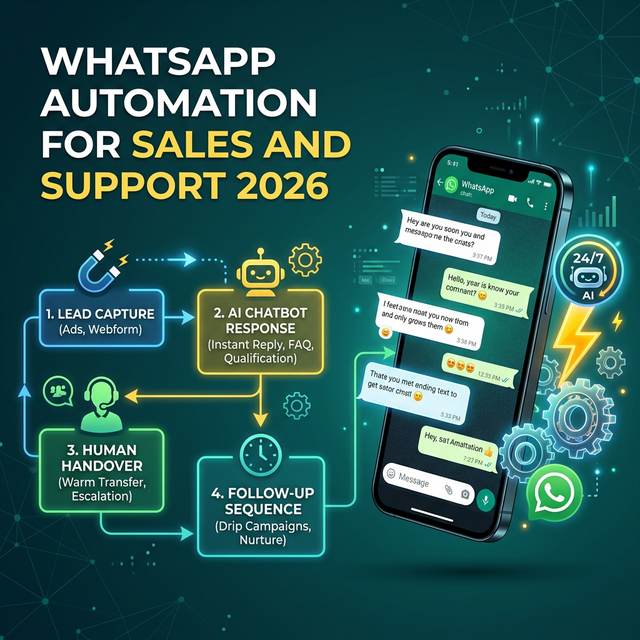
WhatsApp automation through the Business API covers four core functions — and modern platforms let non-technical teams set all of them up without code:
1. Instant Auto-Reply & Keyword Triggers
Set rules so any inbound message containing specific words ("price," "demo," "features," "how does this work") triggers an immediate, personalized response — with the customer's name included. This creates the perception of instant, attentive service, even outside business hours.
2. AI Lead Qualification Bot
An AI chatbot opens a qualifying conversation the moment someone messages your WhatsApp number. It collects: name, company size, use case, budget range, and timeline — through a natural conversational flow. Hot leads are flagged and routed to a sales agent immediately. Cold leads enter a nurture sequence.
3. WhatsApp Drip Sequences
A drip sequence is a series of pre-written messages sent automatically at scheduled intervals after a trigger event (new lead signup, demo request, cart abandonment, post-purchase). Unlike email drips, WhatsApp drips achieve 6–8× higher open and response rates.
4. Human Handover with Full Context
When a conversation needs a human — because the lead is ready to buy, the issue is complex, or the customer explicitly asks for a person — the AI bot smoothly hands over to a live agent. The agent receives the full conversation history, the bot's qualification summary, and the customer profile — so they can jump in without asking the customer to repeat themselves.
WhatsApp Broadcast Campaigns: Your Highest-ROI Marketing Channel
A WhatsApp broadcast campaign lets you send a personalized message to a large contact list simultaneously — all through an official, sanctioned API channel. When done correctly, this is the highest-performing marketing channel available in 2026.
What Makes WhatsApp Broadcasts Different from Email
- Open rates: WhatsApp 98% vs email 21%. Your message is almost certainly going to be seen.
- Response rates: WhatsApp 45–60% vs email 6–8%. Conversations start.
- Speed: A WhatsApp broadcast to 5,000 contacts delivers within minutes. Email campaigns can take 1–2 hours to complete delivery.
- Personalization: Every message can include the recipient's name, company, last interaction date, or any other field from your CRM.
Broadcast Campaign Strategy Guide
Here's how to structure a WhatsApp broadcast campaign that converts:
- Step 1 — Segment your list. Don't broadcast to your entire contact base. Segment by industry, stage in funnel, last interaction date, or product interest. A targeted message to 200 warm leads outperforms a spray-and-pray to 2,000.
- Step 2 — Use an approved template. WhatsApp Business API requires outbound messages to use pre-approved templates for first-touch outreach. Keep the opening line concise, personalized, and with a clear single call to action.
- Step 3 — Send at peak engagement times. Data consistently shows 10–11 AM and 7–9 PM local time as highest response windows for WhatsApp business messages.
- Step 4 — Include a clear CTA with a quick-reply button. "Reply YES to book a demo" or "Tap below to see pricing" buttons dramatically increase response rates compared to text-only CTAs.
- Step 5 — Route responses into automation immediately. Anyone who replies to your broadcast should instantly receive an AI-driven follow-up flow — not sit in a queue waiting for a human.
Real ROI Example: E-Commerce Brand, 30-Day Broadcast Campaign
A mid-size e-commerce brand selling premium home goods ran a 30-day WhatsApp broadcast campaign using TextNow's broadcast feature:
- Contact list: 3,200 opted-in past customers
- Campaign: Weekly product spotlight with personalized recommendation based on past purchases
- Open rate achieved: 94%
- Response rate: 38%
- Purchases attributed: 217 orders within 72 hours of each broadcast
- Average order value: $84
- Revenue generated in 30 days: $54,000+
- Cost of the campaign: <$300 (platform + API message fees)
Compared to their standard email campaign (same list, same period), which generated $7,200 in revenue. The WhatsApp broadcast delivered 7.5× the revenue at comparable cost.
Manual vs. Automated WhatsApp: A Realistic Comparison
Here's what the same day looks like for a sales team of 3 people, with and without automation:
Without Automation
- Morning: manually check and reply to 40+ overnight messages across 3 phones
- Mid-morning: copy-paste broadcast to 80 contacts individually (takes 2 hours)
- Afternoon: follow up with 15 leads who didn't reply yesterday
- Evening: 12 new messages come in after hours — nobody sees them until tomorrow
- Leads handled: ~50. Average first response time: 4.8 hours
With WhatsApp Automation via TextNow
- Overnight: AI bot handles 28 inbound messages, qualifies 9 leads, schedules 3 demos — all while the team sleeps
- Morning: agents see a prioritized inbox with hot leads flagged. Context already collected
- Mid-morning: broadcast campaign sent to 3,200 contacts with 2 clicks — launched in 90 seconds
- Afternoon: agents handle only high-value conversations. Routine questions handled by bot
- Evening: automation continues. No missed leads
- Leads handled: ~200+. Average first response time: under 60 seconds
The WhatsApp Chatbot + Human Handover Model That Actually Works
The fear of chatbots is that they feel robotic and frustrate customers. That's true for poorly designed bots. But the chatbot + human handover model, when implemented correctly, feels seamless — often better than a purely human interaction.
Here's how a well-designed handover flow works:
- Stage 1 — AI handles intake (0–3 minutes): Customer messages. AI greets them by name if returning, or opens a qualification flow for new contacts. Collects need, urgency, and fit. Answers routine questions immediately.
- Stage 2 — Hot/warm/cold classification: Based on responses, the system tags the lead. Hot leads (high intent, right fit, immediate need) get immediate human escalation. Warm leads enter a nurture sequence. Cold leads get educational content.
- Stage 3 — Warm handover to agent: For hot leads, the AI sends a message: "Great — I'm connecting you with our team specialist who can give you a full walkthrough. They'll be with you in under 2 minutes." The agent receives a full briefing card: customer name, company, what they asked, what bot collected, and the recommended next step.
- Stage 4 — Agent takes over with full context: Agent greets the customer by name, references what was discussed, and jumps straight to value — without repeating the qualification. The customer experience feels seamless and professional.
Platforms like TextNow's AI chatbot builder let you build this exact flow visually — no code required — and deploy it on WhatsApp, Instagram, and your website simultaneously.
A Realistic Business Scenario: Real Estate Agency in Dubai
A real estate agency in Dubai receives 150+ WhatsApp inquiries per week from property buyers. Before automation, 3 agents were spending 5–6 hours daily just reading and replying to messages. Serious buyers often waited 6–8 hours for a response — by which time they'd contacted two competitors.
After implementing WhatsApp automation through TextNow:
- AI bot activates instantly on every inbound inquiry — greets the buyer by name (if returning), asks about their budget, preferred area, timeline, and property type through a 5-question qualifying flow
- Leads are classified automatically: serious buyer (budget confirmed, timeline <3 months) routes to agent immediately; early-stage buyers enter a weekly property update broadcast sequence
- Weekly broadcast campaign (new listings, market updates, price drops) goes to 2,800 past inquiries every Sunday — reliably generating 40–60 re-engagements per week
- Agents only handle warm/hot leads — with a full briefing from the AI before they type a single word
Results after 60 days: Qualified viewings per week increased from 11 to 34. Time-to-first-response dropped from 6.4 hours to under 90 seconds. Agent workload dropped 40% despite handling 3× more leads. Monthly revenue increased 2.3× without adding a single agent.
See how this exact setup works for your industry → Book a free 30-minute walkthrough
WhatsApp Automation Implementation Guide: 5 Steps to Go Live
If you're ready to implement WhatsApp automation in your business, here's a practical step-by-step plan:
Step 1 — Get WhatsApp Business API Access
The standard WhatsApp Business app has severe limitations for automation. You need WhatsApp Business API access, which is provided through official Meta Business Solution Providers (BSPs) like TextNow. This unlocks multiple agents, broadcast campaigns, chatbots, and deep analytics. The setup process typically takes 24–72 hours.
Step 2 — Connect Your WhatsApp Number to a Centralized Inbox
Your API-connected WhatsApp number feeds into a centralized omnichannel inbox. Multiple agents can view, reply to, and manage conversations from one shared workspace — with assignments, tags, and conversation history visible to everyone.
Step 3 — Build Your AI Qualification Bot
Using a visual flow builder, map out your ideal qualification conversation: greeting → question 1 (use case/need) → question 2 (timeline/urgency) → question 3 (budget/size) → response based on answers. Add keyword triggers for common inbound scenarios. Include escalation rules. Test the flow by messaging your own number.
Step 4 — Set Up Broadcast Templates & Segment Your Contacts
Create 3–4 WhatsApp message templates for your most common use cases: new lead follow-up, weekly newsletter/update, re-engagement of cold leads, post-purchase follow-up. Get them approved through the API (TextNow handles this for you). Import your contact list and segment by source, stage, or industry.
Step 5 — Run, Measure, and Optimize
Launch your first broadcast campaign and qualification bot. After 72 hours, review: open rates, response rates, bot completion rates, handover rates, and qualified leads generated. Identify the drop-off point in your bot flow and optimize. Most businesses see significant improvement by their third iteration.
See how TextNow's automation and routing features and broadcast campaign tools make every step of this process point-and-click simple. You can also explore the complete omnichannel guide to see how WhatsApp automation fits into a unified engagement stack.
Respond in Seconds. Close More Deals. Zero Extra Headcount.
The gap between businesses that automate WhatsApp and those that don't is widening month by month. The former respond in under 60 seconds, qualify overnight leads before their team wakes up, and run broadcast campaigns that generate 7× the revenue of equivalent email sends. The latter are still copy-pasting messages and losing leads to competitors who got there first.
Unlike ManyChat (primarily Instagram/Facebook) or Twilio (requires developer setup and API expertise), TextNow gives you WhatsApp Business API access, a no-code bot builder, broadcast campaigns, and a centralized inbox for your whole team — in one platform, with no technical complexity. The template approval process? TextNow handles that for you.
Also see how Facebook & Instagram DM automation and building a scalable engagement system complete this infrastructure.
Book a free demo of TextNow's WhatsApp automation → See a live walkthrough of a bot qualification flow, broadcast campaign send, and human handover — all in under 30 minutes.
Frequently Asked Questions
Do I need the WhatsApp Business API to automate WhatsApp?
Yes. The standard WhatsApp Business app has very limited automation — only basic away messages and quick replies. To access broadcast campaigns, AI chatbots, multiple agent inboxes, and proper analytics, you need the WhatsApp Business API. Platforms like TextNow provide API access as part of their service, so you don't need to manage the technical setup yourself.
Is WhatsApp automation compliant with Meta's policies?
Yes — when done through official Meta Business Solution Partners. Outbound broadcast messages require opt-in consent from recipients and use of pre-approved message templates. Inbound automation (AI bots replying to messages sent to your business) has no such restrictions. TextNow operates as an official Meta BSP, ensuring all automation is fully compliant.
How long does it take to set up WhatsApp automation?
API approval typically takes 24–72 hours. Building your first bot flow and broadcast template takes 1–3 hours with a visual builder. Most businesses are running their first automated campaign within one week of starting the process.
Can the AI chatbot handle complex customer questions?
Modern AI chatbots — trained on your product documentation, FAQs, and pricing — can accurately handle 60–80% of routine inbound queries. For complex or high-stakes conversations, the bot escalates to a human agent with full context. The key is designing clear escalation rules so no customer gets stuck in a bot loop.
How is WhatsApp broadcast different from spam?
WhatsApp broadcasts through the API go only to contacts who have opted in to receive communications from your business. Messages must use approved templates for first-touch outreach. Recipients can opt out at any time by replying "STOP." This is fundamentally different from spam — it's permission-based marketing to people who have already shown interest in your business.
What ROI can I realistically expect from WhatsApp automation?
This varies significantly by industry, use case, and list quality. However, common benchmarks from businesses using WhatsApp automation: lead response time cut by 80–95%, lead qualification cost down 40–60%, broadcast campaign revenue 5–8× higher than equivalent email campaigns, and team capacity to handle 3–5× more conversations at the same headcount. Most businesses see ROI within the first 30 days.
About TextNow: TextNow is an AI-powered omnichannel customer engagement platform with native WhatsApp Business API integration, broadcast campaigns, AI chatbot builder, and AI-first customer service for growing sales and support teams. Trusted by ecommerce brands, real estate agencies, and B2B companies across 20+ countries. Learn more about TextNow
Your competitors are already automating. Are you?
Every hour your team spends switching between messaging apps is an hour not spent closing deals or solving problems. TextNow puts WhatsApp Instagram Email and every channel in one place - with AI that qualifies leads and answers questions while you sleep.
No credit card required · 14-day free trial · Cancel anytime