
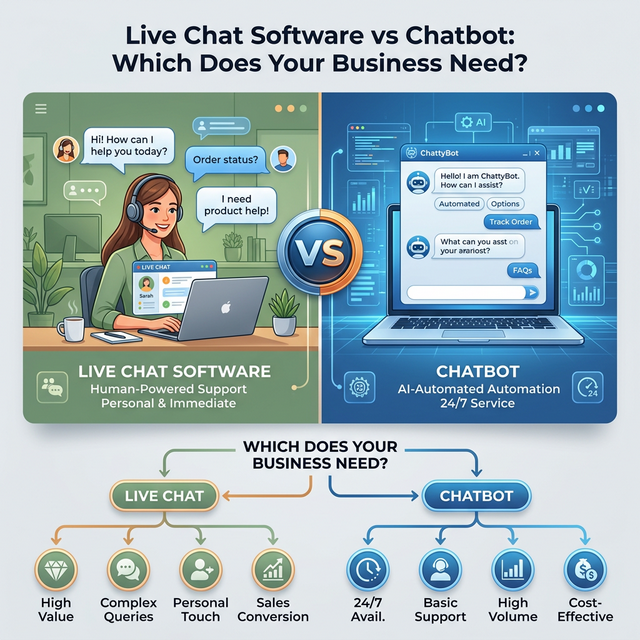
Live Chat vs Chatbot: Understanding the Core Difference
Live chat connects customers with a human agent in real time. Chatbots use AI or programmed rules to respond to customers automatically without human involvement.
For most businesses in 2026, the question isn't "which one?" — it's "how do I deploy both effectively?" The optimal customer service setup uses AI chatbots to handle routine queries automatically (typically 70–90% of volume), and seamlessly hands off complex or high-value conversations to human agents via live chat — with full context preserved at the moment of handover.
But the right starting point depends heavily on your business type, query complexity, team size, and budget. This guide helps you decide.
Live Chat vs Chatbot vs AI-First Hybrid: Full Comparison
| Dimension | Live Chat only | Chatbot only | AI-first hybrid (recommended) |
|---|---|---|---|
| Availability | Business hours only (unless 24/7 team) | 24/7 always on | 24/7 (AI) + human during business hours |
| Response time | Depends on agent availability | Instant | Instant for 70–90% of queries |
| Query complexity handled | Any complexity | Routine and structured only | Routine via AI, complex via human |
| Cost at scale | High — scales linearly with headcount | Low — flat cost regardless of volume | Low — AI handles volume; humans handle edge cases |
| Customer experience quality | High for complex issues; slow for routine | Excellent for routine; poor for complex | Excellent for both with correct handover design |
| Implementation time | Fast (hire agents + use tool) | Weeks (bot design and training) | 2–6 weeks for full deployment |
| Best for | Low-volume, high-complexity queries | High-volume, structured FAQs | Most B2C businesses at growth stage |
When to Use Live Chat Only
Live chat without automation works best when:
- Your query volume is low (<100 conversations per day) — at this volume, a single agent can handle the queue without automation
- Your queries are highly complex or unique — legal, financial advisory, bespoke manufacturing, enterprise sales — where AI cannot reliably give accurate answers
- Your customers expect and value human contact as part of your brand positioning (e.g., ultra-premium services)
- You're in the earliest stage — still mapping your most common queries and don't yet have the data to train an AI bot effectively
The limitation: live chat alone cannot scale. When volume grows beyond 200–300 conversations per day, agent capacity becomes the bottleneck. At this point, automation becomes unavoidable.
When to Use an AI Chatbot Only
Pure chatbot deployments (no live agent fallback) work well when:
- All queries are highly structured — e.g., WISMO (Where Is My Order?) queries for e-commerce, where the bot just needs to look up and return an order status
- Your business operates in contexts where 100% automation is expected — automated SMS alerts, delivery notifications, appointment confirmations
- The stakes of an incorrect answer are low and the cost of providing a human fallback exceeds the risk of the occasional AI error
The limitation: customers often want a human option, even if they don't use it. Completely hiding the escalation path creates frustration and erodes trust when the bot fails.
Why AI-First Hybrid Is the Right Strategy for Most Businesses
The AI-first hybrid approach — where an AI chatbot handles first response across all channels, and seamlessly escalates to a live agent when needed — delivers the best outcomes across all key metrics:
- Cost efficiency: AI resolves 70–90% of queries at a fraction of the cost of live agent handling
- Response time: Instant first response for every customer, 24/7 — no queuing
- Customer satisfaction: Customers get fast answers for routine queries and can always access a human for complex ones
- Agent productivity: Human agents focus exclusively on conversations that genuinely require human judgment, reducing burnout and improving quality
- Scalability: Volume can 10× without a proportional increase in support headcount
TextNow's AI customer service platform implements this model across WhatsApp, Instagram, Facebook Messenger, email, and web chat — with the omnichannel inbox serving as the unified workspace for both AI and human agents.
Live Chat and Chatbot: Channel Considerations
On WhatsApp
WhatsApp is a mobile messaging app, not a website widget. Traditional web live chat tools don't integrate with WhatsApp natively — you need the WhatsApp Business API to manage conversations programmatically and deploy a chatbot. On WhatsApp, AI chatbots are particularly effective because customers are already in an asynchronous messaging mindset — they don't expect an instant human reply, which gives the AI more flexibility.
On Instagram and Facebook
Social DMs are high-intent touchpoints — customers who DM a business on Instagram typically want a fast response. AI chatbots can handle common FAQs, lead qualification, and product queries instantly. Human agents take over for purchase decisions and complaints. The key is speed: 40% of social DMs that don't receive a response within 1 hour result in the customer messaging a competitor.
On Website Chat
Web chat is the traditional home of live chat. It's still the most common first point of contact for B2B businesses and SaaS products. An AI chatbot on your website can qualify visitors, answer product questions, route sales inquiries, and book demos — before a human agent needs to get involved.
How to Choose Between Live Chat Software and a Chatbot Platform
Answer these 5 questions to determine your starting approach:
- What's your daily conversation volume? Under 100/day → live chat first. Over 300/day → AI-first hybrid essential.
- What % of your inbound queries are routine, repeatable questions? Over 60% routine → chatbot will have high ROI immediately. Under 30% → start with live chat, introduce chatbot to handle the structured portion.
- What channels must you support? WhatsApp and Instagram DMs require an omnichannel platform with chatbot capability — traditional live chat tools don't reach those channels.
- Do you need 24/7 coverage? If yes, a chatbot is non-negotiable — you can't staff 24/7 affordably.
- What's your support team size? A 2–3 person team handling 500+ conversations daily needs AI handling at least 70% of volume to avoid burnout.
Ready to deploy an AI-first hybrid? Book a demo or start a free trial.
Your competitors are already automating. Are you?
Every hour your team spends switching between messaging apps is an hour not spent closing deals or solving problems. TextNow puts WhatsApp Instagram Email and every channel in one place - with AI that qualifies leads and answers questions while you sleep.
No credit card required · 14-day free trial · Cancel anytime