
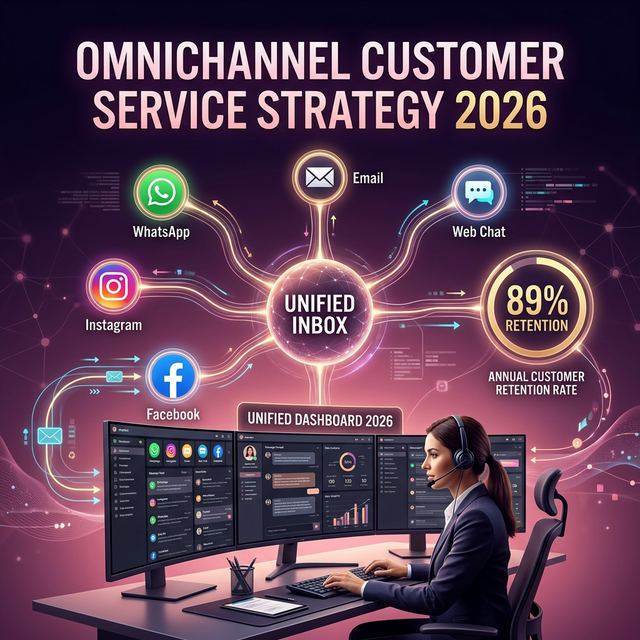
What Is an Omnichannel Customer Service Strategy?
An omnichannel customer service strategy is a framework for delivering consistent, context-aware customer support across every channel a customer uses — WhatsApp, Instagram, Facebook Messenger, email, web chat, and phone — from a single unified system.
The critical distinction from multichannel is continuity. Multichannel means being present on multiple channels. Omnichannel means that a customer can start a conversation on Instagram, continue it on WhatsApp, and reach a human agent on live chat — and at every step, the agent has full context of the entire conversation. No repeating. No re-explaining. No lost context.
In 2026, this distinction is a direct business outcome metric. Companies with strong omnichannel customer service retain 89% of customers on average. Companies with weak omnichannel engagement retain just 33%.
Why Omnichannel Customer Service Matters in 2026
The average customer uses 3+ channels to contact a business in a single customer lifetime. A buyer might discover your product through an Instagram ad, message you on Instagram DM to ask a question, get redirected to WhatsApp for purchase support, and follow up over email when there's an issue.
Each of these touchpoints, handled by a different tool with no shared data, creates what researchers call the "channel switching tax" — the cognitive and emotional cost customers pay when they have to re-explain their situation every time they contact you on a new channel. According to Salesforce's State of the Connected Customer report, 76% of customers expect consistent experiences across departments, but 54% say teams don't share information — leading to them feeling like they're starting over each time.
An omnichannel strategy eliminates this tax. Every agent sees every conversation, regardless of channel. The customer never has to say "as I mentioned before."
Omnichannel vs Multichannel: The Real Difference
| Dimension | Multichannel | Omnichannel |
|---|---|---|
| Channel presence | Multiple independent channels | Multiple connected channels |
| Conversation continuity | Context resets on channel switch | Full history follows the customer |
| Agent view | Different dashboards per channel | Single unified inbox, all channels |
| AI/automation | Separate bot per channel (or none) | One AI, deployed across all channels |
| Customer experience | Fragmented — customer repeats themselves | Seamless — agent has full context |
| Analytics | Siloed per channel, no unified view | Unified CSAT, response time, and volume dashboard |
| Retention impact | 33% average customer retention | 89% average customer retention |
The 4 Components of a High-Performance Omnichannel Strategy
1. Unified Inbox with Full Conversation History
The foundation of any omnichannel strategy is a shared omnichannel inbox where all channels feed into a single interface. Agents see every conversation with a customer — regardless of channel — in one chronological thread. WhatsApp messages, Instagram DMs, Facebook Messenger exchanges, and email threads are all visible in the same customer profile.
This eliminates the most common complaint in multichannel setups: agents asking "did you contact us before?" when the customer has already spoken to two colleagues. The unified inbox means every agent is fully informed before they type a single word.
2. AI-Powered First Response Across All Channels
An omnichannel strategy doesn't just centralise human agents — it centralises AI automation too. One AI chatbot configuration should be deployable across WhatsApp, Instagram, Facebook, and web chat simultaneously. The same knowledge base, the same FAQ training, the same lead qualification flows — just adapted for each channel's formatting conventions.
This is strategically critical for two reasons. First, it ensures consistent first-response quality regardless of channel — no channel gets a "worse" bot than another. Second, it reduces AI training and maintenance overhead dramatically: one update to the knowledge base propagates to all channels instantly.
3. Seamless Human Escalation with Context Preserved
The handover from AI to human is where most omnichannel strategies fail. Poor handover means the customer has to re-explain their issue to the agent — exactly what omnichannel is supposed to eliminate.
A properly implemented omnichannel strategy ensures that when the AI escalates to a human, the agent receives: the full conversation history, the channel it happened on, any qualification data collected (name, issue type, urgency level), and any AI-suggested resolution the bot was unable to deliver. The agent picks up exactly where the bot left off.
4. Proactive Outreach via WhatsApp and Broadcast Campaigns
Omnichannel is not only reactive. A complete strategy includes proactive outreach: reaching customers on the channel they're most likely to open, before they need to contact you. This means:
- WhatsApp broadcast campaigns to segmented opt-in lists — product updates, promotions, event reminders — at 95%+ open rates.
- Triggered sequences based on customer behaviour — abandoned cart, post-purchase follow-up, re-engagement for dormant contacts.
- Appointment and reminder flows — reducing no-shows and missed communications that generate inbound volume.
Omnichannel Customer Service by Industry
E-Commerce
E-commerce brands experience the broadest channel diversity in customer base. Customers discover products on Instagram, purchase on web, ask shipping questions on WhatsApp, and raise disputes over email. An omnichannel inbox consolidates all of this into per-customer threads — with order data visible alongside the conversation. See the E-Commerce automation guide.
Real Estate
Property leads come from multiple sources: property portal messages, Instagram ads, WhatsApp broadcasts, and website inquiries. An omnichannel strategy consolidates all lead channels into one inbox, with AI chatbots qualifying 24/7 and routing to the right agent. Agencies using this approach see 3–5× higher lead response rates. See the Real Estate guide.
Healthcare
Patients contact clinics on WhatsApp (most convenient), receive appointment reminders via SMS, and follow up over email. An omnichannel strategy ensures clinical staff have a complete patient communication history without switching between tools — critical for patient safety and experience. See the Healthcare guide.
Education
Prospective students inquire via multiple channels — WhatsApp, email, and Instagram DMs. Admissions teams using an omnichannel approach respond faster, track every student interaction in one place, and run re-engagement WhatsApp sequences for leads that went quiet. See the Education guide.
How to Build an Omnichannel Customer Service Strategy: 5 Steps
- Audit your current channel landscape. Map every channel your customers currently use to contact you. Survey your team on where the highest volume comes from and where the most context loss occurs. This is your starting baseline.
- Choose a unified omnichannel platform. Select a platform that natively integrates all your key channels into one inbox — not via fragile third-party connectors. TextNow's omnichannel inbox connects WhatsApp, Instagram, Facebook, email, and web chat with full conversation history per customer.
- Deploy AI first-response across all channels. Build your AI chatbot and deploy it to every connected channel simultaneously. Train it on your top 20 FAQ topics first — typically this resolves 60–70% of all inbound volume.
- Define escalation rules and agent routing. Set up clear triggers for when AI hands over to humans: frustration signals, complex queries, VIP customers, and topics outside the AI's training scope. Configure smart routing to ensure the right agent receives each escalation with full context.
- Activate proactive outreach. Move from purely reactive to proactive — launch your first WhatsApp broadcast campaign, set up post-purchase follow-up sequences, and configure re-engagement flows for dormant contacts. Measure open rates, click-through rates, and inbound query deflection on a monthly cadence.
Ready to build your omnichannel strategy? Book a personalised demo or start your free trial.
Key Metrics to Track for Omnichannel Success
- First Contact Resolution (FCR) — % of queries resolved on first contact, without the customer needing to follow up. Target: 70%+ for AI-first omnichannel setups.
- Cross-Channel Repeat Contacts — the % of customers who contact you on more than one channel for the same issue. High scores indicate context is being lost at channel transitions.
- Average Handle Time (AHT) — should decrease as AI handles more volume and agents receive better context on escalations. Typical improvement: 30–40% reduction within 90 days.
- Automated Resolution Rate (ARR) — % of conversations fully resolved by AI without agent escalation. Target: 75%+ for mature deployments.
- CSAT Score by Channel — track satisfaction scores separately per channel to identify where the experience is weakest and prioritise improvement efforts.
Your competitors are already automating. Are you?
Every hour your team spends switching between messaging apps is an hour not spent closing deals or solving problems. TextNow puts WhatsApp Instagram Email and every channel in one place - with AI that qualifies leads and answers questions while you sleep.
No credit card required · 14-day free trial · Cancel anytime