
February 27, 2026
How to Build a Scalable Customer Engagement System for 2026 (Without Hiring More Staff)
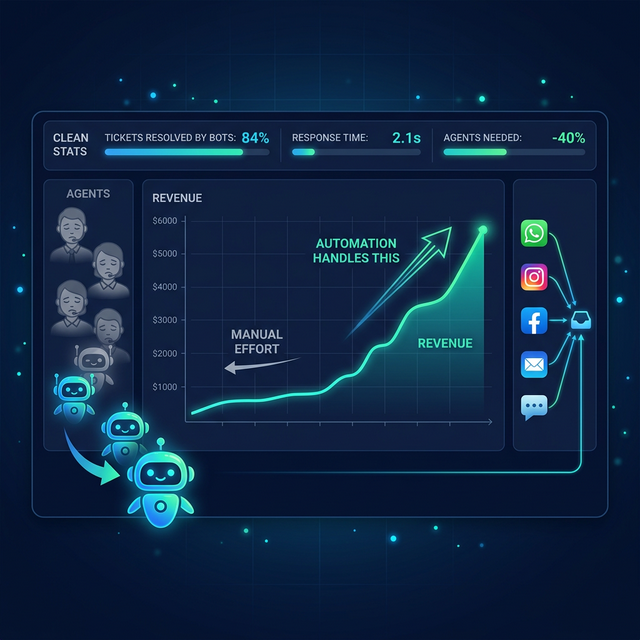
You hired your third customer support agent six months ago. Your ticket volume is already outpacing them. You're looking at hiring a fourth — and the math isn't working. Each new hire adds $40,000–$60,000 in annual salary, plus benefits, onboarding, tools, and management overhead. And yet, 60–70% of the queries they handle are variations of the same five questions.
This is the growth trap that kills the momentum of scaling SMBs. Revenue grows, customer demand grows, support and engagement costs grow proportionally — and margins compress. The companies that break out of this pattern don't do it by hiring faster. They do it by building a customer engagement system that scales with their growth, not against it.
In 2026, that system exists. It combines live chat, AI chatbots, broadcast messaging, and a centralized omnichannel inbox into a single infrastructure that can handle 5× your current query volume without a single additional hire. This guide is your complete blueprint for building it.
The Scaling Support Problem: Why Headcount Doesn't Scale
Most businesses think of customer support as a linear problem: more customers = more agents. But this model breaks at every stage of growth. Here's why:
The Hidden Costs of Hiring
A new customer support hire doesn't cost just their salary. The fully-loaded cost of a support agent — including salary, benefits, equipment, software licenses, management overhead, and training — typically runs 1.3–1.5× their base salary. In most markets, that means each support agent costs $50,000–$80,000 annually.
Beyond cost, there are speed and consistency problems:
- Onboarding takes 4–8 weeks. A new hire can't handle complex queries independently for 6–12 weeks. You're hiring ahead of the need — and paying before they produce.
- Human consistency is limited. Response quality, tone, and accuracy vary by agent, by shift, and by mood. Customers get different experiences depending on who picks up the chat.
- Coverage gaps are expensive. Providing 24/7 support across time zones requires shift work or outsourcing — tripling the cost of "always-on" engagement.
- Repetitive work drives attrition. Support agents handling the same 5 questions 40 hours a week have high turnover rates — which means constant re-hiring and re-training costs.
The Math That Changes Everything
Compare the cost of hiring vs. automation at scale. A business handling 1,500 customer conversations per month:
- Manual model: 3 agents × $55,000/year = $165,000 annually. Maximum capacity: ~1,800 conversations/month. No coverage after business hours. Response time: 2–4 hours average.
- Automation-first model: AI platform subscription ~$400–$800/month ($4,800–$9,600/year). Bot handles 70–80% of queries automatically. 1 human agent handles escalations and relationship-critical conversations. Total cost: ~$65,000/year. Capacity: unlimited. 24/7 coverage. Response time: <10 seconds.
The difference: $100,000+ in annual savings, 24/7 availability, and the ability to handle 3–5× more volume without adding headcount.
The Foundation: Why a Centralized Inbox Changes Everything
Before bots, before broadcast campaigns, before any automation — you need a centralized place where every customer conversation lives. Without this, automation creates fragmentation: your bot handles WhatsApp, your team handles Instagram, a different tool handles email, and nobody has a full picture of any customer.
A centralized omnichannel inbox consolidates every channel — WhatsApp, Instagram, Facebook Messenger, email, web chat, and SMS — into a single workspace. Every agent sees every conversation across every channel. Customer history is unified: when a customer who messaged on Instagram last week emails today, your agent sees the full context immediately.
What a Centralized Inbox Enables
- Unified customer profiles: One contact record per customer, aggregating their conversation history, purchase data, tags, and notes — regardless of which channel they used.
- Shared team workspace: Conversations are assigned, transferred, and escalated between agents within the same inbox — no forward chains, no lost context.
- Bot-to-human handoff: When a bot qualifies a lead or hits a limit, the conversation transfers instantly to a human agent — with the entire bot conversation visible as context.
- Performance visibility: Managers see response times, resolution rates, volume by channel, and agent performance — all in one dashboard.
- Channel-agnostic SLA enforcement: Set response time targets across all channels, not just email. WhatsApp, Instagram, and live chat get the same SLA visibility.
The centralized inbox is the infrastructure everything else is built on. Learn more about TextNow's omnichannel inbox and how it unifies your entire engagement stack.
The Three-Layer Engagement System: Live Chat + Bot + Broadcast
A scalable customer engagement system isn't one tool — it's three layers working in synergy. When all three are connected in a centralized platform, they compound each other's effectiveness.
Layer 1: AI Chatbot (Handle, Qualify, Route)
The AI chatbot is your first responder — available 24/7, instant, and tireless. Its job is threefold:
- Handle: Resolve routine queries immediately — pricing, product info, order status, return policies, FAQs. Well-configured AI bots handle 70–85% of inbound queries without human involvement.
- Qualify: For complex or sales-relevant conversations, the bot gathers key information — budget, use case, timeline, contact details — before a human gets involved. Agents receive pre-qualified leads, not cold inquiries.
- Route: Based on qualification or intent detection, the bot routes conversations to the right agent, team, or department — automatically. Support queries go to support. Sales leads go to sales. Billing issues go to finance.
Explore TextNow's AI chatbot builder — including LLM knowledge base bots and visual workflow builder.
Layer 2: Live Chat with Smart Escalation (Close, Retain, Upsell)
Human agents remain essential — for complex decisions, relationship moments, high-value sales conversations, and situations that require empathy. But in the three-layer model, agents are no longer the first responders. They're the closers.
Smart escalation rules determine which conversations reach humans: high-value leads, frustrated customers (detected by sentiment), escalation keywords, or explicit agent requests. When a conversation escalates, the human agent sees the full context — conversation history, bot interaction log, customer profile, and a recommended next step.
Result: agents spend their time on conversations where they add the most value — not answering "What are your hours?" for the fifteenth time that day.
Layer 3: Broadcast Campaigns (Reach, Nurture, Reactivate)
Broadcast messaging transforms your communication from reactive to proactive. Instead of waiting for customers to reach out, you reach them — at scale, with personalization, through their preferred channel.
- New product announcements sent as WhatsApp or email broadcasts to segmented contact lists — with 40–60% open rates vs 15–20% for traditional email.
- Reactivation campaigns targeting customers who haven't purchased in 60, 90, or 120 days — with personalized offers or check-in messages.
- Post-purchase follow-ups that drive reviews, referrals, and repeat purchases — automatically triggered by purchase events.
- Lead nurture sequences for contacts who engaged but didn't convert — a 5-step drip delivered over 14 days across WhatsApp and email simultaneously.
The synergy: broadcast campaigns bring contacts back into the inbox, where the bot handles initial re-engagement, and agents close the high-intent conversations. One system, three layers, continuous engagement loop. See how TextNow's broadcast campaigns connect to this system.
Step-by-Step Framework: Building Your Engagement System in 30 Days
Week 1: Foundation — Connect & Consolidate
- Day 1–2: Connect all active channels to your centralized inbox — WhatsApp Business API, Instagram, Facebook Page, email, and web chat widget. Migrate existing contact lists.
- Day 3–4: Audit your top 20 most common inbound questions (pull from existing chat logs, support tickets, or email threads). These become the foundation of your knowledge base.
- Day 5–7: Build your AI knowledge base: upload your FAQ document, product pages, pricing information, and policy documents. Test the bot on all 20 common questions. Aim for 85%+ accuracy before going live.
Week 2: Automation — Build & Launch Bot Flows
- Day 8–10: Build your primary qualification flow — the structured conversation your bot runs when a new lead lands in your inbox. Keep it to 4–5 questions. Test across all channels.
- Day 11–12: Configure routing rules — which bot outcomes trigger which agent assignments, which keywords flag for immediate escalation, and which contacts enter a drip sequence.
- Day 13–14: Launch. Go live on your highest-volume channel first (usually WhatsApp or web chat). Monitor for 48 hours before adding additional channels.
Week 3: Broadcast — Create Your Proactive Campaigns
- Day 15–17: Segment your contact list into at least 3 groups: active customers (purchased in last 30 days), warm leads (engaged but not converted), lapsed customers (no activity in 60+ days).
- Day 18–20: Build one broadcast sequence per segment. Active customers → loyalty/upsell campaign. Warm leads → 5-step nurture drip. Lapsed → reactivation offer. Keep each message to 3 sentences maximum.
- Day 21: Schedule and launch your first broadcast campaigns. Monitor open rates, reply rates, and conversion attributions over 7 days.
Week 4: Optimize — Measure, Adjust, Scale
- Day 22–25: Review week 1–3 data: Which bot flows have the highest drop-off? Which broadcast messages drove the most replies? Which escalation triggers are firing correctly?
- Day 26–28: A/B test your highest-traffic bot flows with alternative question phrasing or flow structures. Update your knowledge base with any question the bot couldn't answer confidently.
- Day 29–30: Finalize your engagement system documentation — bot flows, escalation rules, broadcast schedules, and optimization process. This becomes your SOPs for scale.
Want this 30-day framework built specifically for your business — with pre-configured flows?
Book a free strategy session → We'll map out your engagement system in 45 minutes.
Mini Case Study: How a 12-Person SaaS Company Scaled to 3× Users Without Hiring Support
A B2B SaaS company with 12 employees was growing fast — their user base had tripled over 18 months, and their support inbox was flooded. Their two-person support team was handling 800 tickets per month and burning out. Management was planning to hire two more agents at $50,000 each — a $100,000 annual commitment they weren't sure they could sustain.
Instead, they implemented a three-layer engagement system over 30 days:
- Knowledge base bot trained on 3 years of support documentation, product FAQs, integration guides, and billing policies
- Qualification flow for new trial signups — guiding them through onboarding steps and capturing their use case and team size for the sales team
- Broadcast sequences for: trial-to-paid conversion (Day 3, Day 7, Day 12 after signup), feature adoption (triggered by in-app events), and renewal reminders (30, 14, 7 days before expiry)
Results after 90 days:
- Bot resolved 73% of support tickets without human involvement
- Support team's manual ticket load dropped from 800 to 218/month
- Trial-to-paid conversion rate increased from 18% to 31% (broadcast nurture effect)
- Renewal rate improved by 12% (automated renewal reminders)
- Zero additional hires needed — the same 2-person team handled 3× the user base
- Annual cost: $7,200 (platform) vs $100,000 (planned hires) → $92,800 saved in Year 1
ROI Breakdown: What to Expect in Your First Year
The ROI of a three-layer engagement system comes from four sources:
1. Labor Cost Avoidance
If your system handles 70% of queries automatically, you need proportionally fewer agents. For every 1,000 queries per month automation handles, you avoid approximately $45,000–$65,000 in annual agent cost. Most businesses recover platform costs within the first 45–60 days.
2. Revenue from Faster Response
Sales leads responded to within 5 minutes convert at 9× the rate of those responded to after 30 minutes (Harvard Business Review). When your bot responds in <10 seconds, 24/7, your conversion rate on inbound leads increases significantly — even without adding a single sales rep.
A business converting 10 leads/month at $1,500 average deal size ($180,000/year) that improves its conversion rate from 12% to 22% through faster response and bot qualification captures an extra $18,000+ in monthly revenue — $216,000 annually.
3. Revenue from Proactive Campaigns
WhatsApp broadcast campaigns to segmented lists consistently generate 8–15× ROI when messaging is relevant and value-driven. A monthly campaign spending $500 in platform costs that drives $5,000–$7,500 in attributed revenue adds $60,000–$90,000 annually with minimal incremental effort.
4. Retention Improvement
Automated post-purchase follow-ups, loyalty sequences, and renewal reminders consistently improve retention rates by 10–20%. For a business with $500,000 in annual recurring revenue, a 15% retention improvement means $75,000 more revenue retained per year — from automated messages that run without any human effort.
Conservative Year 1 ROI estimate for a 20-person SMB: Labor savings ($80,000) + revenue improvement ($120,000) + retention gains ($40,000) = $240,000. Platform cost: $9,600. Net ROI: 25×.
Growth Roadmap: Your Engagement System at Each Stage
Stage 1: 0–100 Conversations/Month — Start Simple
Focus on the knowledge base bot and centralized inbox. Don't over-engineer. Get the bot handling your top 10 questions. Connect your 2–3 active channels. Measure bot resolution rate and response time. At this stage, you're building habits and processes.
Stage 2: 100–500 Conversations/Month — Add Structure
Introduce qualification flows for new leads. Set up routing rules to direct conversations to the right team member. Launch your first broadcast campaigns — start with a single re-engagement sequence. Target: 60%+ bot resolution rate. Track: agent time freed, lead qualification rate.
Stage 3: 500–2,000 Conversations/Month — Scale Intelligently
Add sentiment detection and smart escalation triggers. Build multiple bot flows for different entry points (website, WhatsApp, Instagram). Segment contacts for 3–5 distinct broadcast sequences. Add A/B testing to your highest-impact flows. Hire your next agent to handle escalations only — not first response.
Stage 4: 2,000+ Conversations/Month — Enterprise-Grade Efficiency
Integrate with your CRM for bi-directional contact sync. Build multi-channel attribution tracking to understand which conversations drive revenue. Implement predictive routing — matching customers to the agent most likely to convert them based on historical data. Introduce proactive engagement: reaching out to customers before they need to reach you, based on behavioral triggers.
Future Trends: Where AI-Driven Customer Engagement Is Heading
The three-layer system described here is the best practice for 2026. But the technology is advancing rapidly. Here's what forward-looking businesses are beginning to implement — and what will become standard within 2–3 years:
Predictive Engagement
AI systems that analyze customer behavior patterns and proactively reach out before the customer has a problem or question. An e-commerce AI that detects a customer looked at the same product 4 times in 3 days and automatically sends a personalized discount via WhatsApp — before the customer leaves for a competitor.
Voice + Text Convergence
Conversational AI is expanding beyond text. Voice bots that handle phone inquiries with the same intelligence as text bots — feeding into the same unified inbox — are entering the mainstream. Businesses that have invested in a unified text-based system now will be best positioned to extend into voice.
AI-Driven Upsell & Cross-Sell
LLM systems trained on purchase history and behavioral data that identify the optimal moment to introduce an upsell — and then execute it conversationally, inside a WhatsApp or chat thread — with less friction than any website popup or email.
Real-Time Sentiment-Driven Routing
AI that detects customer frustration, confusion, or churn signals in real time — and immediately escalates to your best-performing retention agent, not the next available agent in a queue. Combined with agent coaching tools that suggest the best response based on past successful conversations.
Zero-Latency Personalization at Scale
Every message — bot or human — references the customer's specific history, preferences, and context automatically. "Hi [Name], I see you're asking about [Product X] — last time you contacted us, you were using [Product Y]. I'll compare both for you now." This level of personalization, delivered in real time at scale, has historically required a dedicated account manager. AI delivers it to every customer.
TextNow: Your Complete Customer Engagement Infrastructure
What's described in this guide — centralized inbox, AI bot, broadcast campaigns, smart routing, multi-channel deployment — isn't a stack of five different tools. Unlike running Intercom for web chat, Mailchimp for email, and ManyChat for Instagram separately — each with its own contacts, pricing, and integration headaches — TextNow is built to be a single platform that functions as your complete customer engagement infrastructure.
- Omnichannel Inbox — WhatsApp, Instagram, Facebook, email, web chat in one workspace
- AI Chatbot Builder — LLM knowledge base, visual flow builder, Dialogflow connector
- Broadcast Campaigns — segmented messaging with scheduling, analytics, and reply routing
- Automation & Routing — smart escalation, agent assignment, SLA management
Whether you're handling 100 conversations a month or 10,000, the same platform grows with you. You add channels, add bot flows, add broadcast sequences — without switching tools, re-training teams, or rebuilding integrations.
Also see how Facebook & Instagram DM automation and WhatsApp automation fit into this exact infrastructure.
Build Your Engagement System — Before Your Competitors Do
The SMBs winning in 2026 aren't the ones with the biggest support teams. They're the ones that built the smarter system first — and now operate at 3× the capacity with the same headcount, while their competitors are still posting job listings.
The 30-day framework in this guide is achievable with TextNow's platform. Most businesses are live with their core system in under a week.
Book a free strategy session → See the full system built live for your business in 45 minutes.
Frequently Asked Questions
How long does it actually take to set up a three-layer engagement system?
The core system — centralized inbox, basic AI bot, and first broadcast campaign — can be live in 3–5 business days on TextNow's platform. The 30-day framework in this guide assumes a thorough, optimized rollout. Businesses that prioritize speed can compress this to two weeks without sacrificing quality. The longest part is typically gathering your existing content for the knowledge base — which you likely already have in documents, FAQs, or email threads.
How many agents do I still need if I automate 70–80% of queries?
It depends on your volume and the complexity of your escalations. A business handling 500 conversations per month that achieves 75% automation needs a human to handle ~125 conversations — roughly 6–7 conversations per working day. One part-time or one full-time agent can cover this comfortably, with capacity to grow. As volume scales to 2,000+, you typically need 2–3 dedicated agents focused on complex conversations, high-value sales, and critical escalations — not routine queries.
What's the best starting point — bot, inbox, or broadcast?
Always start with the centralized inbox and connecting your active channels — this is the foundation everything else builds on. Second, deploy your AI knowledge base bot on your highest-volume channel (usually WhatsApp or web chat). Third, launch your first broadcast campaign to your warm leads list. Each layer compounds the effectiveness of the others, so the order matters.
Can this system work for businesses with complex or custom products?
Yes — and this is where LLM-based knowledge base bots truly shine. Unlike rule-based bots that struggle with complexity, LLM bots trained on your product documentation can answer nuanced, specific questions about complex products, integrations, and custom configurations. The more thorough your knowledge base, the more effective the bot. Businesses with complex products often see even higher ROI from AI bots — because the cost of a human answering a 10-minute technical question is much higher than for a simple FAQ.
What happens during peak periods — can the system handle sudden spikes?
This is one of the strongest advantages of an AI-first engagement system. While a human support team hits a hard capacity ceiling during peak periods (product launches, seasonal rushes, viral moments), an AI bot scales infinitely with volume. A thousand simultaneous conversations generate the same response time as one. Humans only engage when needed — so the spike in volume hits the bot, not your team.
How do I measure whether the system is working?
Track five core metrics monthly: (1) Bot resolution rate — target 65%+ within 60 days, (2) Average response time — target <60 seconds across all channels, (3) Lead qualification rate — the % of inbound contacts that complete your bot's qualification flow, (4) Broadcast campaign reply rate — target 15%+ for WhatsApp, (5) Agent utilization — the % of agent time spent on high-value conversations vs routine queries. A well-functioning system shows improvement in all five simultaneously.
About TextNow: TextNow is a complete omnichannel customer engagement platform — centralized inbox, AI chatbot builder, broadcast campaigns, and automation routing — built for SMBs scaling without scaling headcount. Deployed across WhatsApp, Instagram, Facebook, email, and web chat from one unified interface. Learn more about TextNow
Your competitors are already automating. Are you?
Every hour your team spends switching between messaging apps is an hour not spent closing deals or solving problems. TextNow puts WhatsApp Instagram Email and every channel in one place - with AI that qualifies leads and answers questions while you sleep.
No credit card required · 14-day free trial · Cancel anytime