
February 27, 2026
What Is Omnichannel Customer Communication? A Complete Guide for Growing Businesses (2026)
Your customer sends a WhatsApp message asking about an order. Your team replies — but the same customer had already emailed two days ago, and messaged you on Instagram last week. Nobody connected the dots. The customer feels invisible, gets frustrated, and leaves a 2-star review.
This is the reality for most growing businesses in 2026. As customers spread across WhatsApp, Instagram, email, Facebook Messenger, and website chat, teams struggle to keep up. Conversations fall through cracks. Response times balloon. Leads go cold. And the fix is not hiring more agents — it's building a proper omnichannel customer communication system.
An omnichannel communication system connects every channel you use into one unified workspace — so your team always has the full picture, bots handle routine questions instantly, and no conversation falls through the cracks regardless of where it started. This guide explains exactly what that means in practice, why it matters in 2026, and how to implement it in your business this month.
What Is Omnichannel Customer Communication?
Omnichannel customer communication is a strategy where all the channels your business uses to interact with customers — WhatsApp, Instagram DMs, email, website chat, Facebook Messenger, Telegram — are connected into a single, unified experience where customer history, context, and conversations are shared across every touchpoint.
The key word is connected. It's not just having multiple channels (that's multichannel). It's ensuring every channel shares context, conversation history, and customer data — so no matter where a customer contacts you, your team (or your AI bot) already knows who they are, what they've asked before, and what they need next.
For the customer, this feels seamless: they can start a conversation on your website chat and continue it on WhatsApp without repeating themselves. For your team, this means fewer missed messages, faster resolution times, and a complete picture of every customer relationship.
Multichannel vs. Omnichannel: What's the Actual Difference?
These two terms are often used interchangeably, but they represent fundamentally different approaches to customer communication:
| Dimension | Multichannel | Omnichannel |
|---|---|---|
| Channels | Present on multiple platforms | All channels connected in one system |
| Customer history | Siloed per channel | Unified profile across all channels |
| Agent experience | Switch between 5–8 apps | One workspace, full context always visible |
| Automation | Per-channel tools | AI and bots work across all channels at once |
| Customer experience | Repeat themselves every time | Seamless — you already know their history |
| Business outcome | 33% avg customer retention | 89% avg customer retention (Aberdeen Group) |
The 89% vs 33% retention gap alone determines whether a business scales or stagnates. In competitive markets, omnichannel communication is no longer an upgrade — it's the baseline.
Why Businesses Are Moving to Omnichannel in 2026
The shift toward omnichannel isn't a trend — it's a structural change in how customers behave. Here's what's driving the urgency in 2026:
- WhatsApp dominance: WhatsApp now has over 3 billion monthly active users globally. In markets across South Asia, the Middle East, Latin America, and Europe, WhatsApp is the primary business communication channel — not email.
- Instagram DM commerce: Instagram has evolved from a brand awareness tool to an active sales channel, with customers inquiring directly via DMs before making purchase decisions.
- AI chatbot expectations: Customers now expect instant responses — 24/7. AI-powered bots on omnichannel platforms can answer 60–80% of routine questions automatically, without any human intervention.
- Team productivity: As businesses grow, managing 10+ communication channels separately with different tools, logins, and context becomes unsustainable. Teams spend hours switching tabs instead of solving problems.
- Personalization at scale: Customers expect you to remember them. Unified customer profiles — built automatically from all their channel interactions — make personalized communication possible without manual effort.
Key Components of a Modern Omnichannel Platform
Not all omnichannel tools are built the same. Here are the core capabilities your platform must have to deliver a truly connected customer experience:
1. Centralized Inbox
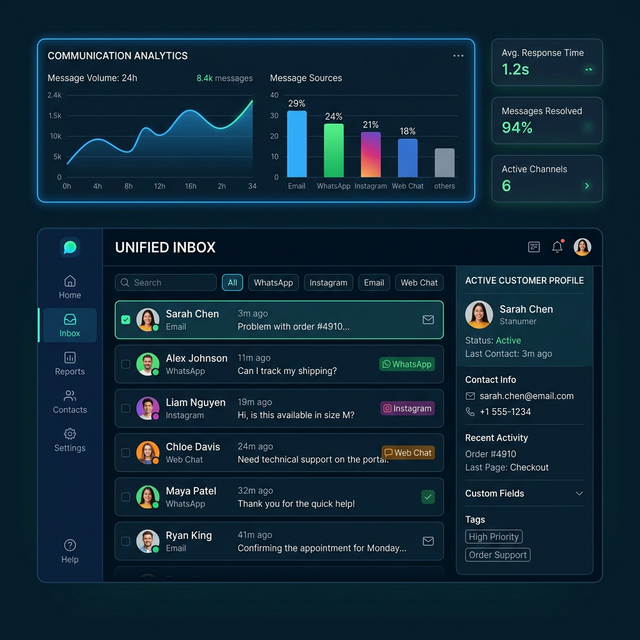
The foundation of any omnichannel strategy is a unified inbox where every message — from every channel — lands in one place. Your team sees WhatsApp, Instagram, email, website chat, and Telegram conversations side by side, with a shared customer profile on the right.
This eliminates channel-switching entirely. One agent can handle multiple channels without toggling between apps or losing context. Conversations are automatically tagged, routed, and prioritized based on rules you set. Learn more about how a centralized omnichannel inbox works on modern platforms like TextNow.
2. WhatsApp Automation
WhatsApp Business API unlocks capabilities far beyond manual messaging. A proper omnichannel platform lets you:
- Set up automated reply flows triggered by keywords, time, or customer action
- Send personalized broadcast campaigns to segmented contact lists
- Build drip sequences for lead nurturing — entirely on WhatsApp
- Route inbound messages to the right team or bot automatically
- Track delivery, read rates, and response metrics in real time
WhatsApp automation is consistently the highest-ROI channel for businesses that implement it correctly — with open rates of 98% versus 21% for email.
3. Instagram DM Automation
Instagram DMs are no longer just customer service — they're pre-sales conversations. A customer who DMs "how much does this cost?" after seeing your reel is a warm lead. Without automation, those leads sit unanswered for hours. With Instagram DM automation:
- Instantly qualify leads who comment or DM with keyword triggers
- Auto-reply with pricing, product details, or booking links
- Capture name, phone number, and email through a conversational DM flow
- Escalate to a human agent when intent is high
This converts your Instagram audience from passive followers into active prospects — without adding headcount.
4. Email Broadcast & Sequences
Email remains essential for B2B communication, follow-ups, and long-form nurturing. Within an omnichannel platform, email isn't isolated — it works alongside WhatsApp and social DMs. You can:
- Send segmented broadcasts to contact lists based on behavior or tag
- Build sequences that combine WhatsApp day 1 → email day 3 → WhatsApp follow-up day 7
- Track opens, clicks, and replies alongside other channel metrics
5. Website Live Chat
A live chat widget on your website captures visitors at peak intent — when they're actively evaluating your product or service. When integrated into an omnichannel platform, this chat:
- Routes to an AI bot first for instant responses, then escalates to human if needed
- Shows the agent the visitor's page history and referral source
- Creates or updates a contact record automatically on first message
- Can offer a WhatsApp or email follow-up option to continue the conversation off-site
6. AI Chatbot Builder
The AI chatbot is the force multiplier of omnichannel. It works across all channels simultaneously — WhatsApp, Instagram, web chat — answering routine questions, qualifying leads, booking appointments, and collecting forms without any human required.
Modern AI chatbot builders let you:
- Train the bot on your own product content, FAQs, and pricing
- Build visual conversation flows with conditional logic
- Set escalation rules: "if customer mentions refund, route to support agent"
- Deploy the same bot across all channels from one interface
Businesses deploying AI chatbots across omnichannel platforms typically resolve 60–80% of routine queries automatically, cutting support costs by 30–50%. Compare AI chatbot builder options in our detailed breakdown, or explore how AI chatbot builders are transforming customer support in 2026.
Real Business Benefits of Omnichannel Communication
The ROI of omnichannel isn't theoretical. Here's what businesses consistently see after implementing a unified communication platform:
- Faster response times: Average first-response time drops from hours to under 2 minutes with AI + routing automation. Businesses that respond within 5 minutes of a lead inquiry see up to 9× higher conversion rates.
- Lower cost per conversation: When AI handles 60–80% of queries, the cost per resolved conversation drops significantly — without reducing quality. Teams handle 3–5× more conversations at the same headcount.
- Higher lead conversion: Automated lead qualification and instant follow-up sequences convert 25–40% more leads compared to manual follow-up, according to Salesforce research.
- Better customer retention: When customers feel heard and get consistent, fast service regardless of the channel they use, repeat purchase rates improve by an average of 30%.
- Team clarity: Agents stop juggling 6 apps and instead work from one inbox, with full context. This reduces errors, speeds up training, and reduces burnout.
- Actionable analytics: A unified platform provides a single dashboard showing message volume, response time, resolution rate, and team performance across every channel — making it easy to identify bottlenecks and improve.
Mini Case Example: How a Real Estate Agency Scaled with Omnichannel
A mid-size real estate agency was managing leads across WhatsApp, Facebook Messenger, their website, and email — each in a separate tool. Their sales team of 4 people was spending 3+ hours daily just reading and replying to messages manually. Hot leads went cold because initial responses took 4–6 hours.
After moving to an omnichannel platform with AI automation:
- All leads from WhatsApp, web chat, and Facebook were routed immediately to an AI bot that collected name, budget, property type, and timeline within 2 minutes of first contact
- The bot automatically qualified leads and assigned hot leads to available agents, cold leads to a WhatsApp drip sequence
- Agents received a full lead profile — with channel history — before starting any human conversation
Results within 90 days: site-to-appointment conversion improved from 18% to 54%. The sales team closed the same number of deals with half the manual workload. Response time averaged under 90 seconds.
Want results like this for your business? Book a free 30-minute walkthrough →
Common Mistakes Businesses Make When Going Omnichannel
Many businesses attempt omnichannel and don't get the results they expected. Here's why — and how to avoid it:
Mistake 1: Confusing "More Channels" with Omnichannel
Adding a new channel without connecting it to the rest of your system just creates another silo. Omnichannel requires a unified platform — not more separate tools.
Mistake 2: Automating Without Personalization
Generic auto-replies ("Thanks for contacting us! We'll get back to you soon.") frustrate customers. Effective automation uses the customer's name, references their inquiry, and provides an actual answer or immediate next step.
Mistake 3: Not Training the AI on Your Own Content
An AI chatbot that answers generic questions is useful. One trained specifically on your products, pricing, FAQs, and policies is transformative. Invest time in building a proper knowledge base before deploying your bot.
Mistake 4: Ignoring Channel Preference
Not all customers prefer WhatsApp. Some prefer email. Some prefer DMs. A true omnichannel strategy lets customers choose their preferred channel and continues that conversation there — rather than forcing everyone into one channel.
Mistake 5: Choosing a Platform Without Scalability
Many businesses start with a cheap point solution — a WhatsApp-only tool, or a basic live chat — and then have to migrate everything again 18 months later when they outgrow it. Choose a platform that supports all channels, AI automation, and team collaboration from day one.
How to Choose the Right Omnichannel Platform for Your Business
When evaluating platforms, ask these questions before committing:
- Which channels are included? Does it natively support WhatsApp Business API, Instagram DMs, Facebook Messenger, email, website chat, and Telegram — or just a subset?
- How is the AI chatbot built? Is it a simple keyword-response system, or a true AI trained on your content? Can you build complex flows visually without coding?
- What does team collaboration look like? Can multiple agents work from the same inbox? How is routing, assigning, and escalation handled?
- Is there a campaign/broadcast feature? Outbound WhatsApp and email campaigns are critical for proactive outreach — make sure the platform supports them natively.
- What analytics are provided? You need visibility into channel-level performance, agent response times, bot resolution rates, and campaign metrics in one dashboard.
- How easy is implementation? A platform requiring months of developer setup will slow your time-to-value. Look for platforms with guided onboarding and setup in under 60 minutes.
- What does pricing look like at scale? Per-message pricing models can become expensive at volume. Look for platforms with predictable monthly pricing that works as you scale.
How TextNow Brings It All Together
TextNow is an omnichannel customer engagement platform built specifically for growing businesses. It unifies WhatsApp, Instagram DMs, Facebook Messenger, Email, Telegram, and website live chat into a single intelligent workspace — with AI automation, team collaboration, and broadcast campaigns included.
Unlike point solutions like Freshdesk (which solves tickets but not WhatsApp) or Intercom (which excels at web chat but requires separate tools for social and broadcast), TextNow is designed as complete omnichannel infrastructure — every channel, every automation, every campaign from one platform. Key highlights:
- Unified inbox: Every channel, every conversation, every customer profile in one place. Assign, tag, filter, and resolve — without switching apps.
- No-code AI chatbot builder: Build AI bots trained on your content that work across all channels — with complex flow logic and human handoff built in.
- WhatsApp & email broadcast: Segment your contacts and send targeted campaigns with personalization, scheduling, and real-time delivery analytics.
- Smart routing & automation: Route inbound messages to the right team, trigger workflows based on keywords or behavior, and automate follow-ups automatically.
- Setup in under 60 minutes: Connect your channels, train your bot, and start handling conversations — with support available from day one.
Explore the full platform: Omnichannel Inbox, AI Chatbot Builder, Marketing & Campaigns, and Automation & Routing.
Ready to Stop Juggling 6 Tools and Start Running One System?
If your team is still jumping between WhatsApp, email, Instagram, and your CRM — every day, for every customer — you're leaving conversion rate, retention, and team productivity on the table. Every missed message, every duplicate reply, every customer who has to repeat themselves: these are the symptoms of a fragmented communication stack.
Also read how WhatsApp automation and Facebook & Instagram DM automation fit into the same omnichannel infrastructure.
Book a free demo → See TextNow unify all your channels live in 30 minutes.
Frequently Asked Questions
What is the difference between omnichannel and multichannel communication?
Multichannel means your business exists on multiple platforms — but each channel operates separately. Omnichannel means all channels are connected, sharing the same customer data, conversation history, and context across every touchpoint. The result is a seamless experience for the customer and a unified workspace for your team.
Which channels should my business prioritize for omnichannel?
Start with the channels your customers already use most. For most businesses, this means WhatsApp (for conversational sales and support), website live chat (for capturing high-intent visitors), and email (for follow-ups and broadcast campaigns). Add Instagram DMs and Facebook Messenger as your second tier based on where your audience is most active.
How long does it take to set up an omnichannel platform?
With a purpose-built platform like TextNow, you can connect your channels and start handling conversations within 60 minutes. Building out a full AI chatbot, routing rules, and automation workflows typically takes 1–2 weeks to optimize — but you'll see results from day one.
Can small businesses benefit from omnichannel communication?
Absolutely. In fact, small businesses benefit most — because omnichannel automation lets a team of 2–5 people handle the volume that would otherwise require 10. A solo founder with a well-configured omnichannel platform can provide enterprise-quality customer communication without an enterprise-sized team.
Does omnichannel communication require technical knowledge to set up?
Modern omnichannel platforms are designed for business users — not developers. You can build AI bots, automation flows, and broadcast campaigns using visual drag-and-drop interfaces. No coding required. API connections for WhatsApp Business are typically handled by the platform's onboarding team.
What ROI can I expect from implementing an omnichannel platform?
Most businesses see measurable results within 30–90 days: faster response times (from hours to under 2 minutes), 25–40% improvement in lead conversion, 30–50% reduction in repetitive support queries (handled by AI), and higher customer retention. The ROI compounds over time as your automation library grows.
About TextNow: TextNow is an AI-powered omnichannel customer engagement platform helping businesses unify WhatsApp, Instagram, Email, and Web Chat in one intelligent workspace. Serving ecommerce brands, real estate agencies, healthcare providers, and marketing teams across 20+ countries. Learn more about TextNow
Your competitors are already automating. Are you?
Every hour your team spends switching between messaging apps is an hour not spent closing deals or solving problems. TextNow puts WhatsApp Instagram Email and every channel in one place - with AI that qualifies leads and answers questions while you sleep.
No credit card required · 14-day free trial · Cancel anytime