
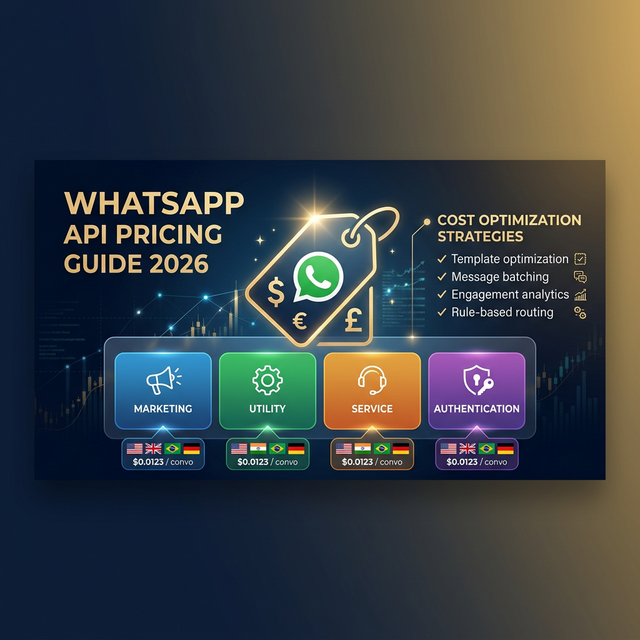
How WhatsApp Business API Pricing Works in 2026
WhatsApp Business API pricing has two components: the platform subscription fee charged by your Business Solution Provider (BSP), and Meta's conversation-based fees. Understanding how each is calculated is critical to accurately forecasting your WhatsApp communication costs.
Since Meta moved to a conversation-based pricing model in 2023 (and further refined in 2024), the cost of WhatsApp Business API is no longer a flat per-message rate. Instead, every billing period is calculated by conversation type, conversation volume, and the country of your customer — making it essential to understand the model before scaling your WhatsApp operations.
This guide breaks down exactly how WhatsApp conversation fees work, what's free, what costs money, and how to calculate your expected monthly bill.
WhatsApp API Pricing: 2 Cost Components
Component 1: Meta Conversation Fees
Meta charges per conversation, not per message. A conversation is a 24-hour messaging window that begins when the first message is sent in an exchange. All messages sent within that 24-hour window count as a single conversation — regardless of how many messages are exchanged.
Meta classifies conversations into four categories, each with a different price:
| Conversation Category | Who initiates | Examples | Typical cost (US)* |
|---|---|---|---|
| Marketing | Business | Promotions, offers, re-engagement campaigns, newsletters | ~$0.025 / conversation |
| Utility | Business | Order confirmations, shipping updates, appointment reminders, invoices | ~$0.004 / conversation |
| Authentication | Business | OTPs, login verification, password reset codes | ~$0.005 / conversation |
| Service | Customer | Inbound customer queries replied within 24h | ~$0.009 / conversation |
* Rates vary by country and are subject to change. The above are US market rates as of early 2026. Contact TextNow for exact rates for your region.
Component 2: BSP Platform Fee
Your Business Solution Provider (TextNow) charges a platform subscription that covers API access, the shared team inbox, AI chatbot, analytics, and support. This is separate from Meta's conversation fees. TextNow's platform plans are available on the pricing page.
What's Free on WhatsApp Business API?
Since June 2023, Meta offers 1,000 free service conversations per month per WhatsApp Business number. This means the first 1,000 customer-initiated conversations each month are entirely free — making WhatsApp particularly cost-effective for businesses that primarily handle inbound support queries.
Additionally, when a customer sends a message and you reply within the 24-hour window, no marketing or utility conversation fee is charged — the reply falls under the free service conversation window (assuming you haven't exceeded the 1,000 free quota).
What is never free:
- Business-initiated marketing messages (promotions, campaigns, re-engagement) — always charged per conversation
- Business-initiated utility messages outside a customer-initiated conversation window (e.g., an order shipped notification sent proactively)
- Business-initiated authentication messages (OTPs)
WhatsApp API Pricing by Country (2026 Overview)
WhatsApp conversation fees vary significantly by country. Markets with higher communication costs (such as North America and Western Europe) attract higher fees, while price-sensitive markets (South Asia, Latin America) are significantly cheaper.
| Market | Marketing (approx.) | Utility (approx.) | Service (approx.) |
|---|---|---|---|
| United States | $0.025 | $0.004 | $0.009 |
| Brazil | R$0.25 | R$0.04 | R$0.08 |
| United Kingdom | £0.055 | £0.009 | £0.019 |
| UAE | AED 0.20 | AED 0.04 | AED 0.08 |
| Germany | €0.083 | €0.013 | €0.029 |
Rates are approximate and change periodically. Always verify current rates in your Meta Business Manager or through your BSP.
How to Calculate Your Monthly WhatsApp API Cost
Use this formula to estimate your monthly WhatsApp API conversation costs:
- Marketing cost = monthly broadcast sends × marketing conversation rate
- Utility cost = monthly utility messages sent (shipping updates, reminders, etc.) × utility rate
- Service cost = max(0, monthly inbound conversations − 1,000) × service rate
- Platform fee = TextNow subscription (see pricing page)
- Total monthly cost = Marketing + Utility + Service + Platform fee
Example: E-Commerce Business (US Market)
Monthly profile: 5,000 marketing broadcasts, 10,000 utility messages (order/shipping), 3,000 inbound support conversations, US market.
- Marketing: 5,000 × $0.025 = $125.00
- Utility: 10,000 × $0.004 = $40.00
- Service: (3,000 − 1,000) × $0.009 = $18.00
- Total Meta fees: $183 / month
For a business handling this volume with an AI bot resolving 70% of support queries automatically, the cost per customer interaction is typically a fraction of the cost of equivalent email or phone support.
WhatsApp API Cost Optimisation: 5 Strategies
1. Maximise the free service window
When a customer messages you first, you have a free 24-hour window. Train your team (and your AI bot) to resolve queries within that window without triggering additional conversations. This alone can significantly reduce your monthly bill for businesses with high inbound support volume.
2. Use utility messages for triggered notifications
Order confirmations, shipping updates, and appointment reminders are classified as utility — much cheaper than marketing. Ensure you're categorising these correctly when submitting templates to Meta. Misclassified utility messages as marketing can 3–8× your notification costs.
3. AI chatbot reduces paid service conversations
When your AI chatbot resolves a query within the customer's initiated conversation, no additional service conversation fee is charged (it's within the existing window). Higher chatbot resolution rates = lower service conversation costs.
4. Segment marketing broadcasts carefully
Every marketing broadcast to an opted-in list triggers a marketing conversation fee per recipient, regardless of whether they reply. Segment your lists aggressively — send to high-engagement segments first, optimise content, and only expand to broader segments once you've validated open and click rates.
5. Monitor conversation data monthly
Review your Meta Business Manager conversation breakdown monthly. Look for unexpected spikes in marketing or utility volumes — these often indicate misconfigured flows that are triggering unnecessary conversations. Most BSPs (including TextNow) provide conversation analytics in the platform dashboard.
Your competitors are already automating. Are you?
Every hour your team spends switching between messaging apps is an hour not spent closing deals or solving problems. TextNow puts WhatsApp Instagram Email and every channel in one place - with AI that qualifies leads and answers questions while you sleep.
No credit card required · 14-day free trial · Cancel anytime